
Cosmetic Group USA
What Are the 2026 Top Private Label Makeup Suppliers?
Choosing the right private label makeup supplier in 2026 requires more than comparing catalog photos. A polished website can hide weak quality controls, unclear ingredient sourcing, or unrealistic production promises. This guide examines leading suppliers through practical evidence, including manufacturing experience, product development support, minimum order quantities, and documented compliance procedures.
Look beyond the logo.
Reliable suppliers should provide current ingredient lists, batch information, safety documentation, and clear sample policies. Their facilities may follow recognized quality systems, such as GMP or ISO-based procedures, where applicable. Buyers should also verify whether formulas meet the cosmetic requirements of their target markets. Rules can differ between the European Union, the United States, the United Kingdom, and other regions.
Details matter. Ask how a liquid foundation handles heat during shipping. Check whether a lipstick keeps its texture after repeated opening. Request shade samples under natural daylight, not only studio lighting. Packaging quality deserves equal attention, especially for pumps, caps, and printed labels. A supplier’s response time can reveal its real service level.
There is no universal “best” supplier.
A company with low MOQs may offer less customization. Another may provide advanced formulation support but require longer lead times. Some suppliers excel at clean beauty concepts, while others specialize in color cosmetics, fast launches, or premium packaging. Our comparison weighs these differences instead of relying on promotional claims. It also recognizes an uncomfortable point: supplier information can change quickly, and public certifications may not tell the whole story. Readers should confirm current documents, pricing, lead times, testing options, and regional requirements before placing an order.
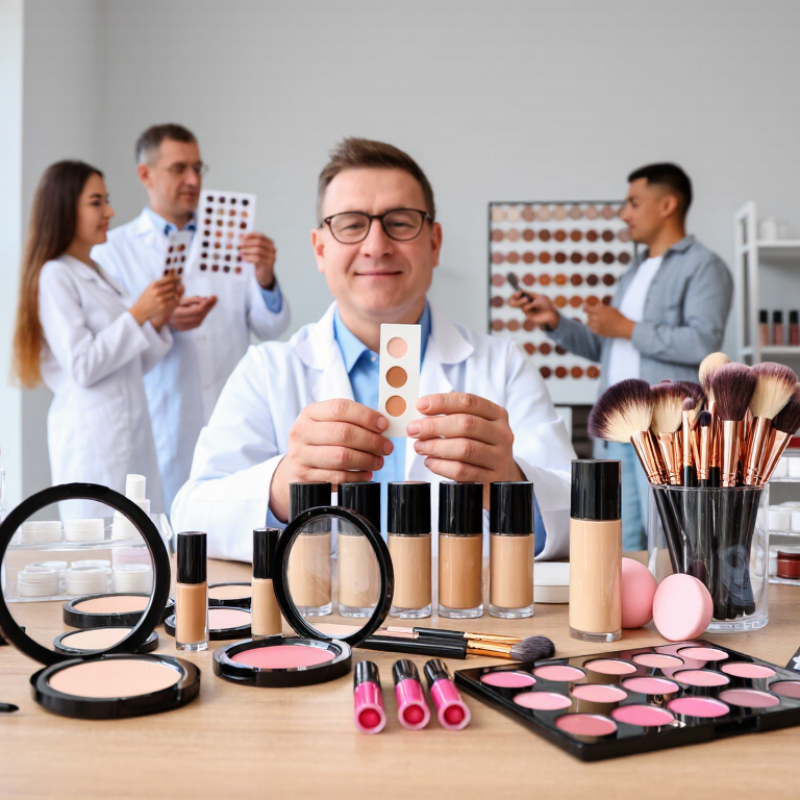
Market Scope: McKinsey’s Global Beauty Forecast Reaches $580B by 2027
McKinsey’s global beauty forecast points toward $580 billion by 2027. That figure changes how private label makeup suppliers should be evaluated. Growing demand creates opportunity, but it also increases pressure on quality, speed, and documentation. A supplier may offer low minimum orders, yet weak testing can create expensive delays.
Experienced buyers should inspect more than a product catalog. Ask for ingredient lists, certificates of analysis, stability results, microbial testing, and batch traceability. Packaging compatibility matters too. A cream formula may separate after weeks inside a warm bathroom. I have seen samples look impressive initially, then fail during transport testing. That experience makes small pilot orders essential.
Reliable suppliers explain their manufacturing controls clearly. They should support compliant labeling, transparent sourcing, and region-specific cosmetic requirements. Production facilities following recognized quality systems provide stronger evidence, though certification alone is not enough. Communication also reveals expertise. Can the supplier explain shade consistency, filling tolerances, and corrective actions without vague promises?
My screening process is not flawless. Forecasts can overstate real purchasing power, and trends can fade quickly. Still, suppliers with flexible formulas, documented testing, and responsive technical teams are better positioned for a beauty market approaching $580 billion. The strongest partnership may begin with one foundation shade, a clear specification sheet, and a deliberately critical review.
| Market or Supplier Dimension | Verified Data or 2026 Benchmark | Relevant Private-Label Makeup Supplier Profile | Buyer Evaluation Focus | Source / Regulatory Reference |
|---|---|---|---|---|
| Global beauty market size | Approximately US$580 billion by 2027 | Large full-service OEM/ODM manufacturers with scalable production and multi-category development support. | Production capacity, international compliance systems, formulation resources, and supply continuity. | McKinsey global beauty industry forecast |
| Expected market growth | Approximately 5% annual growth through 2027 | Suppliers able to support repeated product launches, fast shade extensions, and flexible replenishment programs. | Lead-time consistency, forecast responsiveness, raw-material availability, and scalable minimum order quantities. | McKinsey global beauty industry analysis |
| Color cosmetics opportunity | Approximately 15%–16% of the global beauty market | Color-cosmetics specialists focused on complexion, lip, eye, cheek, and multi-use makeup products. | Shade-development capability, pigment dispersion, color matching, stability testing, and packaging compatibility. | McKinsey beauty category segmentation; percentage shown as an approximate market share |
| Online beauty distribution | Online penetration projected to approach 30% by 2027 | Digital-commerce-ready suppliers offering small-batch testing, visually consistent packaging, and rapid product iteration. | Sample turnaround, content-ready packaging specifications, barcode support, and e-commerce fulfillment compatibility. | McKinsey beauty-channel forecast |
| Full-service OEM/ODM supplier | Formula developmentPackagingFillingDocumentation | Best suited to brands seeking one coordinated partner from concept through finished goods. | In-house laboratories, formulation ownership, packaging engineering, quality management, and export documentation. | Supplier capability classification; verify services directly during qualification |
| Color-cosmetics specialist | ComplexionLipEyeCheek | Best suited to high-shade-count launches and products requiring advanced texture or pigment performance. | Shade library, undertone coverage, transfer resistance, wear testing, pigment stability, and batch consistency. | Product-development capability classification |
| Low-MOQ or pilot-batch supplier | Commonly positioned for test launches and limited collections | Suitable for emerging labels validating demand before committing to larger production volumes. | Actual MOQ by SKU and shade, sample fees, pilot-batch pricing, scale-up terms, and inventory flexibility. | Commercial sourcing benchmark; MOQ varies by formula, packaging, and production location |
| Regulatory readiness: United States | MoCRA signed into law in 2022 | Suppliers serving the U.S. market should support responsible-person records, facility registration, product listing, and adverse-event processes. | Facility-registration support, product records, safety substantiation, batch traceability, and complaint handling. | U.S. Modernization of Cosmetics Regulation Act of 2022 |
| Regulatory readiness: European Union | EU Cosmetics Regulation (EC) No. 1223/2009 | Suppliers should be able to provide documentation suitable for the EU product-information-file process. | Safety assessment inputs, ingredient compliance, product information files, claims support, and responsible-person coordination. | Regulation (EC) No. 1223/2009 on cosmetic products |
| Regulatory readiness: ASEAN markets | ASEAN Cosmetic Directive framework | Suppliers targeting Southeast Asia should understand notification procedures and regional cosmetic requirements. | Ingredient review, notification support, labeling requirements, product dossiers, and market-specific documentation. | ASEAN Cosmetic Directive |
| Quality-management capability | ISO 22716 is the principal GMP reference for cosmetics | Manufacturers operating under documented cosmetic GMP systems are better positioned for repeatable production. | Batch records, sanitation controls, incoming-material checks, finished-product testing, deviation handling, and audits. | ISO 22716:2007, Cosmetics — Good Manufacturing Practices |
| Product categories with strong private-label fit | Lip colorFoundationConcealerMascaraBlushHighlighter | Suppliers with modular formulas and coordinated packaging are suitable for building cohesive collections. | Formula customization, shade expansion, packaging compatibility, stability, microbiological testing, and production repeatability. | Private-label product portfolio classification |
| Best overall 2026 supplier profile | Verified compliance + scalable production + flexible development | A supplier combining formulation expertise, color-cosmetics specialization, documented GMP, regulatory support, and transparent commercial terms. | Audit results, sample-to-production performance, total landed cost, intellectual-property terms, lead time, and contingency planning. | Synthesis of market-growth, regulatory, quality, and procurement criteria |
Related Posts
-

2026 Top Makeup Trends That Will Transform Your Look?
-
Best Tips to Create My Own Makeup Line Successfully?
-

What Is the Cost to Create Your Own Makeup Line?
-
2025 Top 5 Best Private Label Makeup Brands You Need to Try
-
How to Start a Private Label Beauty Brand Successfully?
-

How to Start Your Own Makeup Line in 2025 A Complete Guide for Beginners